
Why Local Warranties Matter More Than National Brands in Beaverton
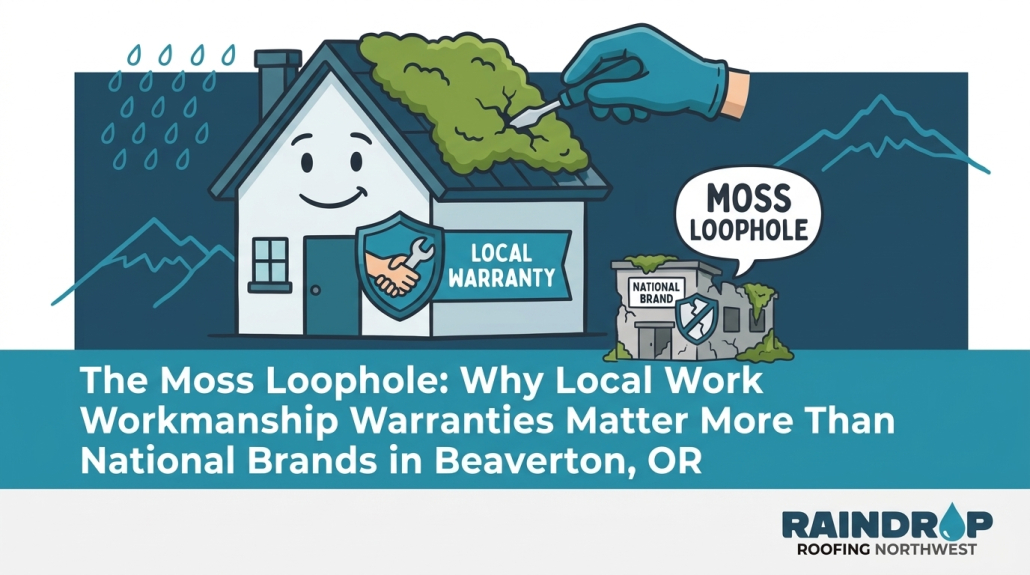
The Fine Print Trap: When National Roofing Warranties Fall Short
Before you finalize a late summer roof replacement, understanding exactly Why Local Warranties Matter More Than National Brands in Beaverton is the most critical step you can take to protect your property. Here at Raindrop Roofing Northwest, our team routinely sees homeowners invest in a brand-new roof, assuming their home is fully protected for decades, only to discover a leak a few years later. When they file a claim, the manufacturer denies it, citing environmental wear or improper maintenance. This frustrating scenario plays out constantly for those who rely entirely on standard manufacturer coverage.
If you are comparing roofing contractors in Beaverton, it pays to understand the difference between a product guarantee and an installation guarantee. National roofing warranties are heavily weighted toward protecting the manufacturer, not the homeowner. These documents are drafted by corporate legal teams based on average United States climate data. They assume a moderate environment with standard rainfall and minimal biological growth.
Because the Pacific Northwest is anything but average when it comes to moisture, relying solely on a standard product warranty leaves your home highly vulnerable. The decision you make before installation—choosing a contractor who backs their work with a localized guarantee versus one who simply passes along a generic manufacturer certificate—will dictate whether you are actually covered when severe weather hits. A localized guarantee steps in exactly where national fine print drops off, ensuring your roof performs in the exact environment where it was built.
Understanding the Limits of Standard Manufacturer Coverage
To navigate roofing protections, you must first understand what standard national manufacturer warranties actually cover. In almost all cases, these warranties are strictly limited to material defects originating from the factory. If a shingle degrades prematurely due to a chemical flaw or a fiberglass matting error during manufacturing, the warranty applies. However, factory defects represent a very small percentage of actual roofing failures.
Standard warranties are typically structured with prorated and non-prorated coverage periods. During the initial non-prorated period, the manufacturer may cover the full replacement cost of defective materials. Once that window closes, the coverage becomes prorated, meaning the value of the warranty drops significantly every year. Eventually, the warranty may only cover a tiny fraction of the replacement cost, leaving you responsible for the vast majority of the financial burden.
More importantly, these warranties explicitly exclude installation errors and environmental damage. If a roof fails because it was nailed incorrectly, or because flashing was improperly sealed, the manufacturer will deny the claim outright. This is why the importance of a workmanship warranty cannot be overstated. A manufacturer warranty only guarantees the shingles as they sit in the wrapper; it does not guarantee how they perform once attached to your home.
Furthermore, in our experience serving the Beaverton area, we’ve found that national brands require strict adherence to standard maintenance guidelines that do not always align with local realities. They mandate specific ventilation ratios and maintenance schedules that might work perfectly in dry climates but fail to account for the persistent dampness of the Pacific Northwest. Failing to meet these rigid, generalized standards gives the manufacturer an easy out to void your coverage entirely.
The ‘Maintenance Negligence’ Loophole and the Moss Threat
The most significant threat to a Beaverton roof isn’t just rain; it is the biological growth that follows. Moss and algae thrive in damp, shaded environments. As moss takes root on your roof, it acts like a sponge, retaining moisture directly against the asphalt shingles long after the rain has stopped. This constant wetness accelerates granule loss, breaks down the asphalt backing, and physically lifts the edges of the shingles, creating pathways for water to penetrate the roof deck.
The corporate classification: Rather than viewing moss as a regional environmental certainty, national brands almost universally classify moss-related deterioration as “maintenance negligence.” In their view, keeping the roof entirely free of biological growth is solely the homeowner’s responsibility. If moss lifts a shingle and causes a leak, the manufacturer will argue that the product did not fail—the homeowner failed to maintain it.
This loophole places a massive burden of proof on the homeowner. If a failure occurs, you may be required to provide years of documentation proving you performed adequate, professional biological growth mitigation. Without this proof, the claim is instantly denied. This clause effectively voids coverage for a massive percentage of homes in high-moisture regions, turning a “lifetime warranty” into a worthless piece of paper.
During a recent late-summer re-roofing project, our crew helped a homeowner who discovered unspecified issues needing repair on the roof joints—areas particularly vulnerable to moisture intrusion and moss accumulation if not proactively fixed. Situations like this require immediate attention to prevent future biological growth from compromising the new system. Taking steps to remove moss and algae from your roofing shingles is critical, but having a warranty that doesn’t instantly penalize you for regional weather patterns is equally important.
How Biological Growth is Legally Classified
When you read the legal jargon in national warranties, terms like “acts of God,” “environmental conditions,” and “external forces” are used to categorize biological growth. Manufacturers legally view moss not as a flaw in their product’s resistance, but as an external force attacking the material. Because they cannot control where the home is located or how many trees surround it, they completely remove themselves from liability regarding biological wear and tear.
Why the Pacific Northwest Climate Demands Specialized Protection
The standard warranty loopholes become glaringly obvious when you apply them to the specific environmental realities of Beaverton. The Pacific Northwest climate is characterized by heavy, prolonged rainfall and consistently high moisture levels from autumn through spring. This creates an unavoidable, ideal environment for moss and algae—the exact conditions that national warranties exploit to deny claims.
National averages simply do not account for the accelerated rate of biological growth in this specific climate. A warranty drafted in a dry, sun-baked corporate office in Texas or a temperate climate in the Midwest offers little practical protection against persistent coastal and valley moisture. The materials are tested against generalized standards, not against nine months of continuous dampness.
Regional adjustments are mandatory: As local roofing experts, we know that standard ventilation and installation guidelines often require regional adjustments to prevent premature failure in Beaverton. For example, a home in a heavily wooded local neighborhood might require enhanced ridge ventilation or specific underlayment upgrades to manage condensation and prevent deck rot. If a contractor strictly follows the national minimums to satisfy the manufacturer, the roof may still fail due to local climate pressures.
A localized approach recognizes that Beaverton’s heavy rainfall isn’t an anomaly; it is the baseline. Protecting a home here requires materials, installation techniques, and coverage plans designed explicitly for high-moisture endurance. Relying on a generic national warranty means you are trusting a document that actively ignores the most destructive forces your roof will face.
The Value of a Local Workmanship Guarantee
The antidote to national fine print is a robust local workmanship guarantee. While a manufacturer warranty covers the materials in a vacuum, a local workmanship guarantee covers the actual installation integrity and the roof’s regional adaptability. It is a promise from the contractor that the entire roofing system was installed correctly and is built to withstand local weather conditions.
Local contractors hold themselves accountable for how the roof performs in the actual environment. If a flashing detail fails during a November downpour, or if unexpected moisture intrusion occurs due to an installation oversight, a workmanship guarantee covers the repair. We recently assisted a local homeowner who experienced severe flat roof leaks after another company’s poor work. It took our team’s professional repair with excellent workmanship to finally stop the leaks, proving that proper installation is the true barrier against water damage.
At Raindrop Roofing Northwest, we provide guarantees tailored specifically to survive Pacific Northwest weather challenges, standing behind our work when national brands hide behind fine print. This local accountability prevents the homeowner from being caught in the middle of a blame game between the manufacturer and the installer. If there is a problem with the installation, a reputable local company fixes it—no corporate bureaucracy required.
Manufacturer Warranty vs. Workmanship Guarantee
Understanding the distinct differences between these two types of coverage is essential for securing expert roof repair in Beaverton without unexpected out-of-pocket costs.
| Feature | National Manufacturer Warranty | Local Workmanship Guarantee |
|---|---|---|
| Primary Coverage | Factory defects in materials only. | Installation errors and system integrity. |
| Environmental Exclusions | Strictly excludes moss, algae, and regional weather wear. | Accounts for local climate realities and moisture challenges. |
| Claims Process | Lengthy corporate review, burden of proof on homeowner. | Direct local response, immediate inspection and repair. |
| Coverage Trigger | Material failure independent of outside forces. | Leaks or failures resulting from how the roof was installed. |

Timing Your Roof Replacement: The Preparation Advantage
Securing the right warranty is only part of the equation; timing the installation correctly ensures that the warranty is never compromised from day one. As the back-to-school season approaches, late summer becomes the critical window for Beaverton homeowners to finalize roof replacements. Waiting until the rainy season begins complicates the installation process and significantly increases moisture risks during the tear-off phase.
Finalizing a roof replacement before heavy fall and winter rains hit ensures that the decking remains dry and the new underlayment is installed under optimal conditions. When materials are installed in dry weather, adhesives seal properly, and shingles lay flat, creating a watertight barrier before the first major storm tests the system. Understanding what actually happens when crows peck at your Beaverton roof or when severe weather strikes highlights why a secure, properly cured installation is vital.
Furthermore, seasonal changes impact roofing materials and installation timelines. Cold temperatures can make asphalt shingles brittle and harder to cut, while persistent rain causes delays that leave your home temporarily exposed. By securing a local workmanship warranty now, during late summer, you ensure complete protection throughout the harshest weather months, knowing the installation was performed flawlessly under ideal conditions.
Checklist: Evaluating a Contractor’s Local Warranty
Not all local guarantees are created equal. When selecting a contractor, you must rigorously evaluate their workmanship warranty to ensure it provides genuine protection rather than empty promises. Use this checklist to verify the strength of a local guarantee:
- Verify the duration: Determine exactly how many years the workmanship guarantee lasts. A standard manufacturer warranty might claim “lifetime” coverage, but the local workmanship guarantee is what actually protects you from leaks.
- Check for voiding actions: Ask for a clear, written list of specific actions that void the guarantee. Ensure that standard local maintenance won’t accidentally cancel your coverage.
- Confirm environmental coverage: Ensure the guarantee explicitly covers issues related to local environmental factors and moisture management, rather than relying on national exclusions.
- Review transferability: Check if the warranty is fully transferable if you decide to sell your home. A transferable local guarantee adds significant value to a real estate transaction.
- Investigate their track record: Confirm the contractor has a documented, long-standing history in the Beaverton area of honoring their local guarantees without leveraging fine print to deny valid claims.
Frequently Asked Questions About Roofing Warranties in Oregon
Does moss void a roof warranty?
The short answer is yes, under most national manufacturer warranties. Standard product warranties classify moss and algae growth as maintenance negligence rather than a material defect. If moss causes your shingles to lift or lose granules, national manufacturers will typically deny the claim, making local workmanship guarantees that account for regional weather essential.
What is the difference between a manufacturer warranty and a workmanship warranty?
A manufacturer warranty covers factory defects in the physical roofing materials, while a workmanship warranty covers the quality of the installation. Because the vast majority of roof failures stem from improper installation or regional environmental factors rather than defective materials, the workmanship guarantee provided by your local contractor is often your most valuable protection.
How long should a roofing workmanship warranty last?
A dependable roofing workmanship warranty typically lasts between 5 to 10 years, though some premium contractors offer longer terms. This timeframe is crucial because installation errors—such as improper flashing or incorrect nailing patterns—usually reveal themselves during the first few major seasonal weather cycles.
What does a contractor workmanship warranty cover?
A contractor workmanship warranty covers any leaks, failures, or damage resulting directly from improper installation techniques. This includes fixing botched flashing, replacing improperly nailed shingles, and addressing unexpected moisture intrusion that occurs because the roofing system was not assembled according to best practices.
Why do national roofing warranties exclude environmental wear like algae?
National roofing warranties exclude environmental wear because they are written to apply broadly across all United States climates. Manufacturers cannot control local weather patterns, tree coverage, or moisture levels, so they categorize biological growth as an external force and place the burden of mitigation entirely on the homeowner.
Can a local workmanship guarantee protect against Pacific Northwest weather damage?
Yes, a strong local workmanship guarantee is specifically designed to ensure your roof withstands Pacific Northwest weather. While it won’t stop moss from growing, it guarantees that the roof was installed using techniques and materials chosen specifically to manage heavy local rainfall and prevent moisture intrusion, holding the installer accountable for regional performance.
Secure True Peace of Mind for Your Next Roofing Project
National warranties serve as a necessary baseline, protecting you against rare factory defects, but they are not a comprehensive safety net. The heavy rainfall and high moisture levels of Beaverton require more than generic fine print. Local workmanship guarantees provide the true protection you need, ensuring your roof is installed correctly and backed by professionals who understand regional environmental threats.
Addressing your roof replacement before the rainy season begins is the smartest way to secure a flawless installation. Do not leave your home vulnerable to the moss loophole. Speak with a local expert today to understand your protection options, evaluate localized guarantees, and ensure your next roofing project delivers genuine, long-lasting peace of mind.




Trackbacks & Pingbacks
[…] of manufacturer guidelines requires a clear understanding of regional expectations. Grasping why local warranties matter is a crucial step in maintaining your home’s defense system across Beaverton and the greater […]
[…] is exactly why local warranties matter more than national brands. A robust workmanship warranty from a local contractor guarantees that the roof was installed […]
[…] who may look for any excuse—like a small patch of moss—to deny the claim. Understanding why local warranties matter more than national brands is a critical part of making an informed investment in your home’s […]
[…] manufacturer is risky in our climate. To truly protect your investment, you need to understand how local workmanship warranties provide a much stronger safety net against the specific environmental challenges we face in […]
[…] home remains dry even when the rain doesn’t stop for weeks. Taking the time to understand local workmanship warranties ensures you are actually protected when you need it […]
[…] these boundaries is why understanding local workmanship warranties is highly recommended before signing a contract for solar […]
[…] DIY scraping or using unapproved chemical solvents can instantly void your coverage. Understanding why local warranties matter for moss-related roof damage highlights the importance of hiring experts. Working with professionals who have deep local […]
Leave a Reply
Want to join the discussion?Feel free to contribute!