
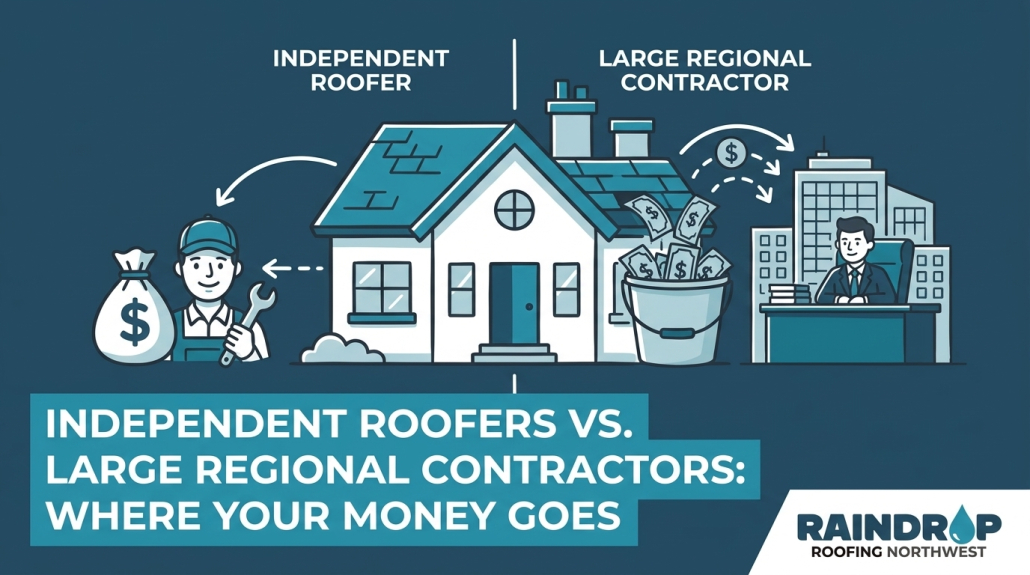
Independent Roofers vs. Large Regional Contractors: Where Your Money Goes
Myth: A Higher Roofing Bid Always Means Better Materials
Assuming a higher quote automatically guarantees superior shingles and premium underlayment is a common myth, which is why understanding the true difference between independent roofers vs. large regional contractors: where your money goes is critical for your home. If you are comparing bids for a late-summer residential tear-off before the fall rains arrive, you are likely trying to decipher why quotes for the exact same roof size differ so dramatically. At Raindrop Roofing Northwest, we regularly speak with homeowners who are incredibly frustrated by staring at three different proposals, all promising a great roof, yet featuring vastly different final numbers.
The truth is, the final number on a roofing bid is heavily influenced by a company’s underlying business model, not just the physical materials going onto your house. When you hire a contractor, you are not just buying shingles and nails; you are funding their entire operational structure. If you are looking for reliable roofing contractors in Beaverton, your goal is to evaluate competing bids to ensure your investment actually goes into protecting your home rather than paying for corporate overhead.
Homeowners in Beaverton residential neighborhoods often notice these stark differences when gathering quotes during the busy season. By learning how to read between the lines of a standard estimate, you can confidently choose a team that prioritizes structural integrity over high-pressure sales tactics. Let us break down exactly how the hidden economics of roofing quotes work, so you know exactly what you are paying for.
The Anatomy of a Standard Roofing Estimate
To understand why quotes vary so widely, you first need to understand the baseline costs required to replace a roof. Every legitimate roofing company, regardless of size, faces the same fundamental expenses. The problem arises when homeowners cannot distinguish between the necessary costs of building a great roof and the unnecessary costs of running a bloated corporate machine. Before consulting with a roofer, it helps to know exactly how a standard estimate is built.
The solution is to mentally separate a bid into two distinct categories: the money that stays on your roof, and the money that leaves your driveway. During the August pre-fall rain rush, urgency often exposes which companies operate efficiently and which ones rely on heavy markups to survive the peak season.
Direct Costs vs. Indirect Costs
A transparent roofing estimate is built on a foundation of direct costs. These are the tangible elements that directly impact the quality and lifespan of your new roof.
- Raw Materials: This includes the structural underlayment, ice and water shields, starter shingles, the primary architectural shingles, ridge caps, and specialized flashing. Premium materials cost more upfront but last significantly longer.
- Skilled Labor: This covers the wages paid to the actual crew performing the tear-off, structural repairs, and installation. Paying competitive wages attracts experienced, detail-oriented installers.
- Waste Disposal: Tearing off an old roof generates thousands of pounds of debris. Direct costs include dumpster rentals, recycling fees, and landfill disposal charges.
Indirect costs, on the other hand, are the expenses required to keep the business running. Every company has overhead—essential licensing, comprehensive insurance, office space, and basic administrative support. Furthermore, every sustainable business must build in a reasonable profit margin; otherwise, they will not be around in ten years to honor their warranties. The massive variance in roofing bids almost always comes down to how a company manages these indirect costs.
The Corporate Overhead of Large Regional Contractors
Large, multi-state or regional roofing chains operate on a completely different financial scale than local businesses. Their business model relies on high volume, which requires a massive, constant influx of new leads. To sustain this volume, they must spend heavily on marketing and sales infrastructure. When you receive a bid from a large regional contractor, a significant percentage of that total number is allocated specifically to fund their corporate overhead.
Marketing Budgets and Massive Fleets
Think about the roofing advertisements you see every day. Prime-time television commercials, daily radio spots, full-page magazine spreads, and towering highway billboards cost an extraordinary amount of money. Large regional chains spend heavily on these campaigns to dominate brand awareness. Additionally, they maintain massive fleets of heavily branded, late-model trucks. While a professional appearance is important, wrapping and maintaining a fleet of fifty vehicles is an indirect cost that must be recouped. That money is recouped directly through higher customer bids.
Multi-Tiered Sales Commissions
Perhaps the biggest driver of inflated bids is the corporate sales structure. Large regional contractors frequently employ dedicated, commission-only sales teams. When a representative sits at your kitchen table in a Beaverton residential neighborhood, their primary goal is to close the deal, because their paycheck depends on it. In many corporate structures, the salesperson takes a hefty percentage off the top. Then, a regional sales manager takes a cut. Finally, a branch manager takes a percentage.
All of these commissions are paid out before the actual installation crew even unloads a single bundle of shingles. This multi-tiered management structure shifts a massive portion of your budget away from the actual roof. You are ultimately paying for the marketing that got the salesperson to your door, and the commission that keeps them there, rather than investing that same amount into higher-grade underlayment or better ventilation systems.
The Lean Advantage of Independent Local Roofers
In stark contrast to the corporate model, independent local roofers operate with a fundamentally lean structure. They do not have regional directors, massive call centers, or multi-million-dollar advertising budgets. Instead of relying on television commercials, they rely on doing excellent work in the community, which generates organic word-of-mouth referrals. This leaner operational model creates a massive advantage for the homeowner.
Working with a local, independent contractor means there are fewer layers of corporate management and marketing overhead baked into your quote. As a result, a much higher percentage of your budget goes directly into securing high-quality materials and paying skilled local labor for your tear-off. During the busy August pre-fall rain rush, independent roofers can adapt quickly to neighborhood-specific requirements without waiting for corporate approval.
Comparing the Two Business Models
To clearly see where your investment goes, look at this side-by-side comparison of how different business models allocate their revenue:
| Business Component | Large Regional Contractors | Independent Local Roofers |
|---|---|---|
| Marketing Approach | Expensive TV, radio, and billboard campaigns. | Word-of-mouth, local reputation, and community ties. |
| Sales Structure | Commission-based sales reps and middle management. | Direct consultation with the owner or a dedicated project manager. |
| Budget Allocation | Heavy percentage goes to overhead and corporate profits. | Majority of the budget goes directly to materials and labor. |
| Agility & Flexibility | Rigid corporate pricing models and standardized materials. | Flexible, neighborhood-specific solutions tailored to your home. |
Because independent roofers carry significantly lower operational overhead, they do not need to artificially inflate their bids to cover massive indirect costs. This allows them to offer highly competitive quotes while still utilizing top-tier materials. You are funding the roof itself, not the corporate machine behind it.

How Overhead Impacts Material Quality and Climate Prep
The business model a contractor uses directly impacts the quality of the materials they install. High-overhead companies often rely on standardized, bulk-purchased materials to maximize their profit margins. A corporate buyer in another state might purchase massive quantities of a standard shingle to supply all their West Coast branches. However, standardized materials are rarely optimized for specific micro-climates.
In the Pacific Northwest, heavy rainfall and persistent moss require specific local roofing knowledge. In our years of replacing roofs across the Portland metro area, our team at Raindrop Roofing Northwest has seen firsthand how standardized corporate materials fail in our unique environment. Because local roofers have lower overhead, they have the budget flexibility to invest in specialized, high-performance underlayment and heavy-duty, moss-resistant shingles that actually stand up to the local weather.
Solving Real Neighborhood Problems
Local expertise leads to much better problem-solving, especially for older homes facing unique moisture issues. For example, one homeowner in a Beaverton residential neighborhood recently dealt with significant moss damage and moisture trapped under the eaves of their older home. Because they worked with a local team that understood the specific climate challenges, the crew was able to carefully tear off the old roof, remove all the accumulated debris, and upgrade the ventilation by replacing loud, inefficient metal vent covers. The result was a quiet, leak-free roof with protected landscaping—a tailored solution that a standardized corporate package might have missed entirely.
When planning a roof replacement in Portland or the surrounding suburbs, the long-term return on investment is always higher when a larger portion of your bid is dedicated to heavy-duty materials designed specifically for the local climate.
Labor and Workmanship: Who is Actually Installing Your Roof?
Another major difference between business models lies in how they handle labor. The problem with large regional contractors is that they frequently act as sales organizations rather than dedicated roofing craftsmen. To manage their high volume of sales, especially during the August pre-fall rain rush, many corporate chains sub out the actual installation work to third-party crews. The company that sold you the roof is often not the company installing it.
This subcontracting model creates a dangerous disconnect. The third-party crew is usually paid the lowest possible rate so the regional contractor can maintain their profit margin. When crews are rushed and underpaid, quality control plummets. Corners get cut, flashing is rushed, and cleanup is often sloppy.
The Value of Dedicated Local Crews
The solution is to look for independent roofers who maintain consistent, dedicated crews. Local roofers rely heavily on their reputation, which means they must maintain strict quality control on every single job. Because they operate with low corporate overhead, they can afford to pay competitive wages to highly skilled local laborers.
When the people working on your home are paid fairly and treated well, they take pride in their workmanship. They take the time to properly install ice and water shields, perfectly align the shingles, and meticulously clean your yard before leaving. This level of dedication directly impacts the lifespan of your roof, which directly supports robust local workmanship warranties. If a local crew installs it right the first time, the warranty actually means something.
Reading Between the Lines: Evaluating Your Late-Summer Bids
Now that you understand the hidden economics of roofing, you need a practical way to analyze the competing bids sitting on your table. Evaluating quotes is not just about looking at the final number at the bottom of the page; it is about reading the itemized scope of work to see exactly where your money is going.
Use this actionable framework to evaluate your bids and ensure you are making a smart investment for your home in Beaverton residential neighborhoods:
- Examine the itemized materials: Does the bid specifically list the brand and type of underlayment, shingles, and ventilation? Vague terms like “standard underlayment” are a red flag. Look for specific, moss-resistant materials tailored to the Pacific Northwest.
- Ask about the installation crew: Look the contractor in the eye and ask, “Are the people installing my roof your direct employees or dedicated crews, or do you sub this out to the lowest bidder?” The answer will reveal exactly how they approach quality control and accountability.
- Evaluate responsiveness and scheduling: How quickly did they return your call? A professional local roofer respects your time. For example, one local family needed an urgent roof replacement before selling their parents’ house on a tight deadline. Because they worked with an agile local team, they received a prompt bid, the replacement was scheduled quickly, and the job was completed efficiently using high-quality materials.
- Review the cleanup plan: Tearing off a roof is messy. The bid should explicitly state how they will protect your landscaping, manage the dumpster, and sweep for stray nails using magnetic rollers.
- Watch for high-pressure sales tactics: If a representative tells you the price is only good if you sign right now, ask them to leave. Manufactured urgency is a clear sign of a commissioned salesperson trying to secure their cut, rather than a professional consultant helping you make a sound decision.
Make an Informed Decision for Your Home
Understanding where your money goes empowers you to make the best long-term choice for your property. A new roof is a major structural investment, and you deserve to know that your budget is being spent on premium materials and skilled labor, rather than funding a corporate marketing machine.
As the August pre-fall rain rush approaches, take the time to look past the final number on the page. Prioritize bids from independent contractors who clearly invest in their crews and use heavy-duty materials designed for our local climate. By choosing a contractor whose business model aligns with quality installation rather than high-volume sales, you protect your home for decades to come. Reach out to our team at Raindrop Roofing Northwest today for a transparent, consultative conversation about your upcoming roofing project, and ensure you are paying for true craftsmanship.
Frequently Asked Questions
Why are roofing quotes so different?
Roofing quotes vary wildly because you are not just paying for materials; you are paying for the company’s business model. Large regional companies have massive overhead costs, including television advertising, large vehicle fleets, and multi-tiered sales commissions, which inflate their bids. Independent local roofers operate with much leaner overhead, allowing them to provide competitive quotes where a higher percentage of the budget goes directly into the roof itself.
Is it better to use a local roofing company or a large chain?
Working with a local independent roofing company generally provides a better return on your investment. Local roofers have lower corporate overhead, meaning more of your budget pays for high-quality materials and skilled labor rather than corporate marketing. Additionally, local roofers have a deeper understanding of the specific weather challenges in your area, allowing them to recommend the right moss-resistant materials for the Pacific Northwest.
Do large roofing companies sub out their work?
Yes, many large regional roofing contractors subcontract their installation work to third-party crews to keep up with high sales volume. This can lead to a lack of quality control, as the crew installing the roof may be rushed or underpaid by the corporate chain. Independent roofers are much more likely to use consistent, dedicated crews, which ensures better workmanship and a more reliable installation process.
How do sales commissions affect the cost of my new roof?
Sales commissions directly inflate the final cost of a roofing bid without adding any structural value to your home. In large corporate models, the salesperson, regional manager, and branch manager all take a percentage of the total sale before any materials are purchased. By choosing a company without a heavy, commission-based sales structure, your money is spent on better underlayment, stronger shingles, and experienced installers.
Why is local Pacific Northwest experience important for moss prevention?
The Pacific Northwest experiences heavy, persistent rainfall and high humidity, creating the perfect environment for destructive roof moss. A local roofer understands these unique micro-climates and knows exactly which moss-resistant shingles and specialized ventilation systems are required to protect your home. Large regional chains often use standardized, bulk-purchased materials that simply are not designed to withstand local moisture levels.
What should I look for in a roofing bid besides the final price?
You should carefully review the itemized scope of work to see exactly what materials are being used and how the labor is structured. Look for specific brands of underlayment and shingles rather than vague descriptions, and verify whether the company uses dedicated crews or subcontractors. Furthermore, check for clear details regarding yard protection, daily cleanup protocols, and the specifics of their local workmanship warranty.




Trackbacks & Pingbacks
[…] company manages the entire scope of work, nothing falls through the cracks. They understand the difference between independent roofers and large regional contractors, and they apply that local focus to your […]
[…] several alarming characteristics that leave loopholes for future billing. If you are comparing independent roofers vs. large regional contractors, checking for these omissions is a great way to filter out unprofessional […]
Leave a Reply
Want to join the discussion?Feel free to contribute!