
How Peak July Sun Exposes Hidden Blisters in Older Asphalt Shingles
When Summer Heat Reveals Hidden Roof Bubbles
When you are trying to figure out how peak July sun exposes hidden blisters in older asphalt shingles, the first thing you probably notice are strange, raised bumps scattered across your roof. Here at Raindrop Roofing NW, our team fields dozens of calls every summer when the Pacific Northwest finally hits its peak heat. Looking up at your house during a 95-degree July week might reveal an unwelcome surprise. You step out to the driveway, glance upward, and see what looks like bubbles or a severe rash spreading across your shingles.
It is easy to feel immediate anxiety. Is the roof going to cave in? Is water going to pour into the living room during the next rainstorm? In our experience, the first decision you face is determining whether these strange blisters are just a superficial cosmetic flaw or a critical waterproofing failure that demands immediate action.
Before you panic, it helps to understand that this bubbling is a specific reaction to extreme temperature shifts. It does not necessarily mean your roof is on the verge of structural collapse today. However, knowing what you are looking at is the first step toward protecting your home. Whether you need reassurance or it is time to look into professional roofing services, understanding the symptoms is your best defense against unexpected leaks.
What Exactly Are Asphalt Shingle Blisters?
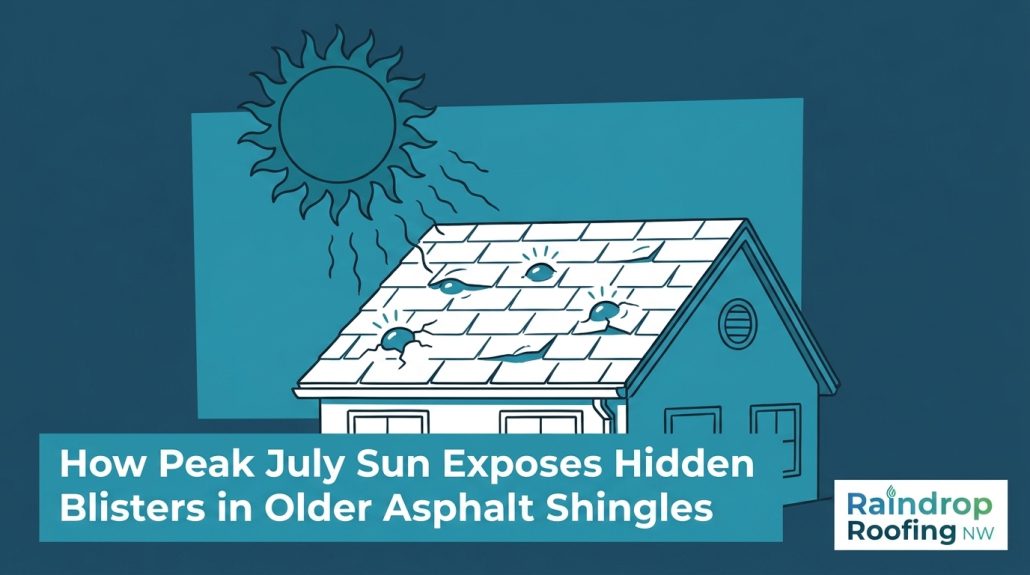
To the untrained eye, blistering looks like someone slipped marbles or small pebbles under your roofing material. These raised, pimple-like bumps can vary dramatically in size across the surface of your roof. Some might be as small as a pencil eraser, while others can grow to the size of a quarter or larger, disrupting the smooth, flat profile your roof is supposed to have.
Manufacturing Solvent Blisters
Sometimes, the root cause goes all the way back to the factory floor. Manufacturing solvent blisters happen when volatile gases from the asphalt mixing process get trapped inside the shingle layers during production. When the roof eventually heats up under intense sunlight, these trapped gases expand, pushing the surface material upward to form a bubble.
Moisture-Induced Thermal Blisters
Based on the roofs our team replaces across Beaverton OR, the more common culprit is moisture-induced thermal blistering. Over time, as a roof ages, it loses some of its natural protective oils and becomes significantly more porous. Microscopic amounts of water vapor get trapped within the inner layers of the shingle. Under high heat, this trapped moisture expands rapidly, forcing the asphalt outward.
Why Older Roofs Are Vulnerable
Older shingles are far more susceptible to this phenomenon because years of gradual wear, tear, and weather exposure have compromised their outer defenses. The older the asphalt, the easier it is for ambient moisture to sneak in and wait for the summer sun to trigger a violent reaction.
The Pacific Northwest Climate Connection: From Wet Winters to Peak Heat
Living in Beaverton OR means your home goes through a very specific weather cycle that is particularly hard on exterior materials. Our long, notoriously wet winters combined with heavy seasonal moss growth create an environment where moisture is constantly sitting on your roof. Over several months, water slowly seeps into the microscopic cracks and crevices of aging shingles.
Then comes the sudden climatic shift. We transition from months of high precipitation and overcast skies straight into sudden, intense dry heatwaves. This environmental whiplash creates the perfect storm for roof damage. The moisture that spent six months comfortably hiding inside your shingles suddenly has nowhere to escape when the intense summer sun hits the roof deck.
At Raindrop Roofing NW, our local crews have spent years documenting exactly how this unique expansion and contraction cycle affects roofs in our specific area. We know firsthand what materials endure when transitioning from wet Oregon winters to peak summer heat, and our team knows exactly how to spot the signs that a roof is struggling to keep up with the shifting seasons. It is this specific regional climate pattern that turns a slightly porous older roof into a landscape of heat blisters.
The Physics of Thermal Shock During Extreme Temperatures
To really grasp why your roof bubbles up so dramatically, you have to look at the math behind the heat. Something our technicians frequently explain to homeowners is that the temperature on the ground is vastly different from the temperature on top of the house. In direct sunlight, asphalt shingles can reach temperatures 50 to 60 degrees higher than the ambient air temperature.
That means during a typical 95-degree July week, your roof surface temperatures can easily exceed 150 degrees. Darker shingles absorb even more thermal energy, pushing that number even higher. This extreme heat creates a condition known as thermal shock.
At 150 degrees or more, any trapped moisture inside the shingle layers cannot remain liquid. It rapidly turns into vapor. Because vapor takes up significantly more space than liquid water, it expands violently. With nowhere else to go, this expanding vapor pushes the asphalt and the protective colored granules upward, forming a distinct blister on the surface of the shingle. The faster the temperature rises on a hot afternoon, the more aggressive this expansion becomes.

Blistering vs. Hail Damage: Spotting the Difference
When our team conducts summer roof evaluations, it is incredibly common for homeowners in Beaverton OR to confuse heat blisters with hail damage. While both leave your roof looking battered and uneven, we always emphasize that they are fundamentally different problems with different solutions. Distinguishing between the two is vital, especially if you plan on filing an insurance claim, because adjusters look for very specific markers of impact damage.
| Feature | Hail Damage | Thermal Blistering |
|---|---|---|
| Root Cause | Sudden top-down physical impact | Progressive bottom-up thermal expansion |
| Visual Shape | Indented bruises or small craters | Raised, pushed-out bumps or bubbles |
| Fiberglass Mat | Often fractured or broken from the strike | Usually intact unless the blister has severely popped |
| Granule Loss | Pushed down into the asphalt mat | Flaked off the very top of the raised bubble |
Hail strikes from the sky, forcefully crushing the protective granules down into the asphalt mat and often bruising the fiberglass backing beneath. Blistering, on the other hand, is an inside-out problem. The pressure builds from beneath the surface and pushes outward. If you rub your hand over a hail strike, it feels like a small crater. If you run your hand over a blister, it feels like a small hill.
Ground-Level Diagnostic Checklist for Homeowners
If you suspect your roof is suffering from heat-induced bubbling, your first instinct might be to grab a ladder. We strongly advise our customers against this: climbing onto a 150-degree roof is a terrible idea. Not only is it a severe safety hazard during a 95-degree July week, but our crews know firsthand that walking on hot, pliable asphalt shingles can easily cause permanent scuffing and tear the granules right off the mat.
Instead, use this safe, ground-level diagnostic checklist we recommend to assess the severity of the situation:
- The Binocular Test: Stand across the street or at the far edge of your yard with a pair of binoculars. Slowly scan the surface of the roof, looking specifically for raised bumps or a textured, uneven profile against the sky.
- Check for popped blisters: Look closely at the tops of the bumps. Are the colored granules still attached, or has the blister “popped” to reveal shiny, black asphalt underneath?
- Assess the scope and location: Is the bubbling isolated to just one slope, or is it widespread across the entire roof? Blistering is usually most prominent on the South or West-facing slopes because they receive the most direct, intense afternoon sunlight.
- Inspect the gutters: After a heavy summer breeze, check your downspouts for an excessive accumulation of colored roof granules. Heavy granule shedding often indicates that blisters are popping.
If you notice severe granule loss or see that the bubbles have opened up, it is time to contact us for a roof inspection to determine the next steps.
Cosmetic Flaw or Critical Waterproofing Failure?
A pattern we see often is that not all blisters require an immediate roof replacement. The severity depends entirely on the physical condition of the blister itself.
When It Is Just Cosmetic
Cosmetic blistering occurs when the bumps are fully intact. If the blister has risen but the protective granules are still firmly in place shielding the asphalt, the shingle’s waterproofing capabilities are likely still uncompromised. Your roof can continue to shed water effectively in Beaverton OR, even if it looks a bit textured. We typically tell homeowners they can safely continue to monitor intact blisters.
When It Becomes a Critical Failure
The situation shifts to a critical failure the moment those blisters pop. Once the top of the bubble breaks off, the raw black asphalt is exposed directly to the sun’s harsh UV rays. Without the protective granules reflecting the light, the exposed asphalt will rapidly dry out, crack, and degrade. This creates a direct pathway for water to seep down to the roof deck, inevitably leading to interior leaks.
The Role of Attic Ventilation
Our roofing specialists also consistently note the role of attic ventilation in this process. Poor ventilation traps massive amounts of heat inside your attic, essentially baking the shingles from the bottom while the sun bakes them from the top. This double-sided heat exposure exacerbates the internal pressure, turning a minor cosmetic issue into a critical failure much faster. Proper airflow is essential for keeping those shingle temperatures manageable.
Protecting Your Roof Through the Summer Heat
Seeing bubbles on your shingles during a 95-degree July week can certainly be alarming, but having our expert team evaluate the damage can determine if your home’s integrity is truly at risk. The key is proactive assessment. You want to identify and address popped blisters before the current heatwave turns into the next season’s heavy rain cycle, bringing active leaks right into your living room.
A thorough professional evaluation from Raindrop Roofing NW will give you the exact condition of your shingles, the state of your attic ventilation, and a clear path forward to keep your home protected. Schedule your roof inspection before the weather shifts again, ensuring your home is ready for whatever the Pacific Northwest brings next.
Frequently Asked Questions
What causes asphalt shingles to bubble?
Asphalt shingles bubble when trapped moisture or manufacturing solvents expand under extreme heat. During the summer, roof temperatures can exceed 150 degrees, causing any trapped water vapor inside the material to rapidly expand and push the shingle surface upward. This phenomenon is most common in older roofs that have become porous over time.
Do blistered shingles need to be replaced immediately?
Not always, as it depends heavily on whether the blister has popped. If the blister is intact and the protective granules are still in place, it is largely a cosmetic issue that can simply be monitored. However, if the blister has popped and exposed the raw asphalt beneath, we recommend those specific shingles be replaced promptly to prevent water intrusion.
Is blistering on a roof covered by homeowners insurance?
Generally, homeowners insurance does not cover blistering because it is classified as a manufacturing defect or standard wear-and-tear, rather than a sudden, accidental event. Insurance typically covers sudden impact damage like hail strikes or fallen branches. You will need a professional inspection to definitively prove the cause of the damage to your insurance adjuster.
How long do blistered shingles last once they appear?
An intact blistered shingle can still function and shed water for several years, depending on the severity of the local weather and your roof’s ventilation. Once the blister pops and loses its granules, the shingle will degrade rapidly under UV exposure. At that point, it may only take a few months before water begins to penetrate the fiberglass backing.
Can poor attic ventilation cause shingle blistering in the summer?
Yes, in our extensive experience repairing roofs, poor attic ventilation is a major contributing factor to shingle blistering. Without proper airflow, excessive heat gets trapped in the attic space, essentially baking the shingles from the underside. This added thermal stress accelerates the expansion of trapped moisture and causes blisters to form and pop much faster than they would on a well-ventilated roof.




Leave a Reply
Want to join the discussion?Feel free to contribute!